Wearable metric
Waist circumference
WC · Waist-hip ratio (WHR) · Central adiposity
A tape measure beats the BMI scale for cardiometabolic risk: central fat is the part that matters.
What it measures
The circumference of the abdomen at a standardised landmark (midway between the lowest rib and the iliac crest, per WHO protocol). Captures abdominal (visceral + subcutaneous) fat, the deposit most strongly associated with insulin resistance, dyslipidaemia, hypertension, and cardiovascular events. Waist-hip ratio (WHR = waist ÷ hip) adds the lower-body deposit as a normaliser.
Reference context
5 guideline sources
Waist circumference is a stronger predictor of cardiometabolic events than BMI when both are measured. INTERHEART (n=27,098) and PURE cohorts have confirmed this across ethnic groups, with ethnicity-specific thresholds because abdominal fat distribution differs.
Population context: consult guideline targets below
Mechanism
Why moving this marker matters
Visceral adipose tissue is metabolically active, releasing free fatty acids, inflammatory cytokines (IL-6, TNF-α), and adipokines into portal circulation. It correlates with ectopic fat in liver, pancreas, and muscle. Two people at the same BMI can have markedly different visceral fat; waist circumference captures the difference that BMI misses.
Guideline targets
What major guidelines recommend
IDF 2006 (Europid men)
<94 cm; ≥94 cm indicates increased risk; ≥102 cm substantially increased
IDF 2006 (Europid women)
<80 cm; ≥80 cm increased; ≥88 cm substantially increased
IDF 2006 (South Asian, Chinese, ethnic-specific)
Lower thresholds apply: men ≥90 cm, women ≥80 cm
WHO WHR (men)
<0.90
WHO WHR (women)
<0.85
How to measure
The test, where to get it, when to repeat
Method
Standing, after exhaling, tape measure horizontal at the midpoint between the lowest rib and the iliac crest (WHO protocol). Snug but not compressing. Two measurements, take the average. WHR: also measure hip circumference at the widest point over the buttocks.
Where
Free at home with any tape measure.
Typical cost
Free (€5 for a tape measure).
Fasting
Not required
When to test
WHO 2008
18+Useful at any age; track monthly when working on body composition, otherwise annually.
IDF 2006 (metabolic syndrome)
Central component of the IDF metabolic syndrome criteria, required for diagnosis.
How to track
Devices and apps that measure this
These consumer wearables and connected devices report this metric. Healicus is not connected to your device. Your data lives in the maker's app and never reaches us.
Healicus is not the provider. Your contract for the service is with whoever you choose. Links labelled Sponsored are paid affiliate relationships; unlabelled links are editorial reference only. See our disclosure for the full policy.
Context
Reading the numbers
Waist circumference is a stronger predictor of cardiometabolic events than BMI when both are measured. INTERHEART (n=27,098) and PURE cohorts have confirmed this across ethnic groups, with ethnicity-specific thresholds because abdominal fat distribution differs.
Caveats
Tape technique matters: landmark drift gives spurious changes. Use the same technique each time. Pregnancy, recent abdominal surgery, and significant ascites invalidate the measurement for body-composition purposes.
Practices
What's been shown to influence this marker
PREDIMED-Plus: Mediterranean pattern + caloric restriction + physical activity reduced waist circumference by ~5 cm over 12 months in adults with metabolic syndrome.
 Habit
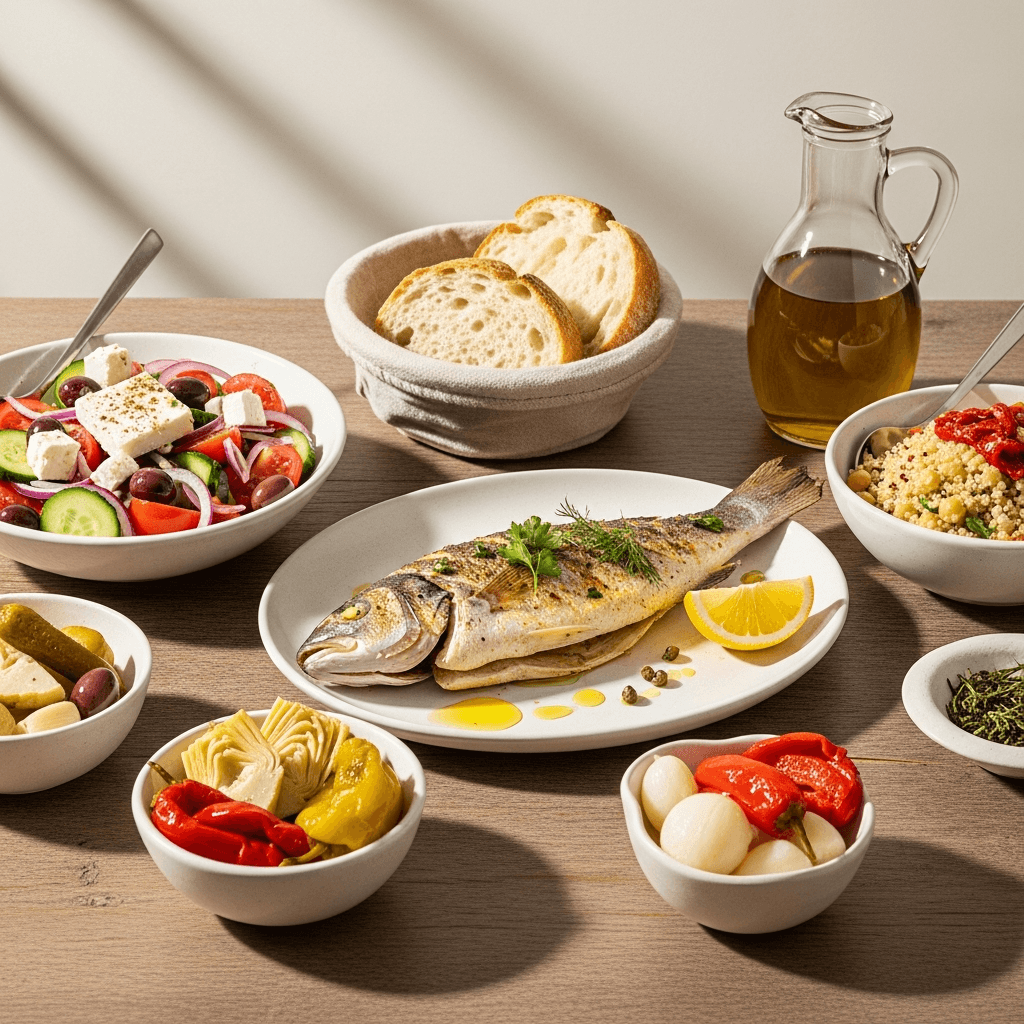
HabitMediterranean dietary pattern
Olive oil, fish, nuts, legumes, plants. The most-studied diet for cardiovascular and cognitive longevity.
Why
The Mediterranean pattern, heavy on plants, olive oil, fish, nuts, legumes; moderate fish and dairy; light on red meat, has the strongest evidence base of any specific diet for long-term cardiovascular and cognitive outcomes. PREDIMED, the largest trial, showed ~30% reduction in major cardiovascular events vs. low-fat control.
Slot in your day
How to do it
How
Olive oil as the primary fat. Plants at every meal. Fish 2–3× per week. Nuts daily (small handful). Red meat once a week or less. Wine optional, with food.
Sticking with it
Stock the kitchen for one week's pattern. Decisions live in the shopping list, not at mealtime.
Markers this may influence
Evidence
PREDIMED (Estruch 2018 NEJM, n=7,447, 4.8-y follow-up): a Mediterranean diet plus extra-virgin olive oil or mixed nuts vs. a low-fat control diet, ~30% reduction in major cardiovascular events (MI, stroke, CVD death). Sofi 2014 updated meta-analysis (n>4M) confirms a dose-response association with all-cause and cardiovascular mortality.
 CautionHabit
16:8 intermittent fasting
16-hour overnight fast, 8-hour eating window. Not new, monastic traditions have done it for centuries.
Why
A daily eating window of about 8 hours (e.g., noon to 8pm) with the rest of the day fasted. Often improves insulin sensitivity and reduces visceral fat in trials, though the mechanism is largely the spontaneous calorie reduction it produces rather than fasting per se. Easy entry-level intervention.
Slot in your day
How to do it
How
Skip breakfast or skip dinner. Black coffee, tea, water during the fast. No special protocol needed; consistency over weeks matters more than perfection on any one day.
Ideal for
People with metabolic syndrome, insulin resistance, or who tend to graze.
Sticking with it
Decide your eating window for the week, not the day. Drift is the failure mode.
Markers this may influence
Evidence
Patikorn 2021 JAMA Network Open umbrella review (11 meta-analyses): intermittent-fasting protocols (including 16:8 time-restricted eating) produced modest reductions in body weight, fasting glucose, and LDL-C vs control diets, the effect is largely mediated by the spontaneous calorie reduction the eating window produces. No clear superiority over conventional caloric restriction.
 Habit
HabitZone 2 cardio
Conversational-pace cardio, 150+ minutes per week. Mitochondrial backbone of healthspan.
Why
Zone 2 is the intensity at which you can still hold a conversation but a song would be a stretch, roughly 60–70% of max heart rate. Sustained Zone 2 work increases mitochondrial density, improves fat oxidation, and is the single most consistently associated exercise input with all-cause mortality reduction in cohort studies.
Slot in your day
How to do it
How
Brisk walk, easy bike, slow jog. 30 minutes × 5 days, or 45–60 min × 3 days. The 'talk test' is the simplest gauge.
Ideal for
Anyone over 30; especially valuable as the foundation before adding higher-intensity work.
Sticking with it
Schedule it like a meeting. The session you 'fit in if there's time' is the session that doesn't happen.
Markers this may influence
Evidence
Lee 2012 Lancet Physical Activity Series (population-attributable risk analysis across >50 cohorts): physical inactivity caused ~9% of premature mortality worldwide, comparable to smoking and obesity. Kelly 2014 meta-analysis of walking and cycling (n=280,000 + n=187,000): each ~11 MET-h/week of either activity was associated with ~10–11% lower all-cause mortality.
 Habit
HabitResistance training
2 sessions/week. Preserves muscle mass: the marker that tracks functional independence in your eighties.
Why
Sarcopenia (age-related muscle loss) starts in the third decade and accelerates from 50. Resistance training is the only intervention shown to reverse it. Two sessions per week of full-body work is enough to maintain mass; three is enough to build it. Critical for fall prevention, bone density, and insulin sensitivity in older age.
Slot in your day
How to do it
How
Six compound movements (squat, hinge, push, pull, carry, rotate), 2–3 sets each, 2× per week. Bodyweight is fine to start; progress to weighted as form solidifies.
Ideal for
Everyone, especially those over 40; the cost of starting late is much higher than starting early.
Sticking with it
Two fixed weekday slots beat 'three sessions whenever'. The schedule is the programme.
Markers this may influence
Evidence
Westcott 2012 Curr Sports Med Rep review: 2–3 weekly sessions of resistance training in older adults produced ~1.4 kg of muscle gain and ~1.8 kg fat loss over 10 weeks, with parallel gains in resting metabolic rate and glucose handling. The only intervention shown to reverse age-related sarcopenia, which begins in the third decade and accelerates after 50.
 Habit
HabitReduce ultra-processed food
UPF intake correlates with mortality independent of total calories. The category, not just the calories, matters.
Why
Foods classified as ultra-processed (NOVA group 4), packaged snacks, sweetened drinks, reformulated meats, ready meals, predict cardiovascular and all-cause mortality even after adjusting for total calories and macronutrient profile. Mechanisms include altered satiety signalling, additive effects, and displacement of whole foods.
Slot in your day
How to do it
How
Aim for the bulk of the diet to be foods you'd recognise in a kitchen 100 years ago. Convenience foods are fine occasionally; the issue is when they become the default.
Sticking with it
Don't fight cravings in front of the cupboard, fight them at the supermarket.
Markers this may influence
Evidence
Lane 2024 BMJ umbrella review (45 meta-analyses across ~10 million participants): higher ultra-processed food intake was convincingly associated with all-cause mortality, cardiovascular mortality, type 2 diabetes, and common mental disorders, effects persisting after adjusting for total calories and macronutrient profile. The category, not just the calories, predicts risk.
See also
Related markers
Take to your physician
Worth discussing
- Whether your waist measurement, BMI, and other markers together suggest metabolic syndrome.
- If above your ethnicity-specific threshold, what targeted lifestyle measures are appropriate.
- Whether body composition imaging (DEXA, MRI) would add useful information beyond a tape measurement.
Sources
Cited literature
- [1]WHO Expert Consultation, Waist circumference and waist-hip ratio: report of a WHO expert consultation(2011)
- [2]Alberti et al., IDF, The metabolic syndrome: a new worldwide definition(2005)
- [3]Ross et al., Waist circumference as a vital sign in clinical practice: a consensus statement from the IAS and ICCR Working Group on Visceral Obesity (Nat Rev Endocrinol)(2020)
- [4]Yusuf et al., INTERHEART, Obesity and the risk of myocardial infarction in 27,000 participants from 52 countries (Lancet)(2005)
- [5]Salas-Salvadó et al., PREDIMED-Plus, Effect of a lifestyle intervention with energy-reduced Mediterranean diet and physical activity on weight loss and CV risk factors(2019)
Last reviewed May 2026
Keep reading
← Previous
Wearable metric
Blood pressure
The single most modifiable cardiovascular risk factor. Home monitoring is more informative than the occasional office reading.
Next →
Wearable metric
Sleep regularity index
How consistent your sleep–wake timing is from day to day. In a 60,000-person UK Biobank study it predicted mortality better than how long you slept.