Lab marker
Testosterone (total)
Total testosterone · TT
The principal androgen, modestly informative for libido, energy, body composition, and bone health in men.
What it measures
Total serum testosterone, the sum of free, albumin-bound, and SHBG-bound testosterone. Reported in nmol/L (SI) or ng/dL (US units). Declines naturally with age in men; in women, contributes to libido and lean mass.
Reference context
2 guideline sources
Reference ranges vary by assay and lab. Two confirmed low morning values plus consistent symptoms are needed before considering replacement. Population averages decline gradually with age, but treatment decisions should rest on symptoms and confirmed lab evidence, not age alone.
Population context: consult guideline targets below
Mechanism
Why moving this marker matters
Testosterone supports skeletal muscle protein synthesis, bone mineralisation, erythropoiesis, libido, and mood. Symptomatic male hypogonadism, confirmed low testosterone plus consistent symptoms, is associated with reduced quality of life and worse cardiometabolic profile.
Guideline targets
What major guidelines recommend
Endocrine Society 2018 (men, lower limit of normal)
~10.4 nmol/L (~300 ng/dL) on a morning fasting sample
Common reference (men, mid-range)
~13–25 nmol/L (~380–720 ng/dL)
How to measure
The test, where to get it, when to repeat
Method
Fasting morning blood draw (testosterone follows a diurnal rhythm, peaking 7–10am). LC-MS/MS preferred over immunoassay at lower concentrations.
Where
GP request or private lab.
Typical cost
€20–50 private.
Fasting
Required
When to test
Endocrine Society 2018 (men)
maleMeasure in men with consistent symptoms (low libido, fatigue, depressed mood, reduced muscle mass). Repeat for confirmation before treating.
ISSWSH 2021 (women)
femalePostmenopausal women with hypoactive sexual desire disorder may have testosterone measured; otherwise routine measurement not recommended.
Where to test
Independent labs offering this test
Healicus refers you to independent laboratories. You order from the lab; they take the sample, run it, and return your result on their own platform. Healicus never sees your value.
Randox Health
UK · EU · INTLClinic-based premium panels — wider biomarker breadth than home-test brands.
Visit Randox Health
Synlab
DE · EU · INTLEurope-wide medical lab network — referrals via partner GPs and direct-to-consumer programmes where offered.
Visit Synlab
Cerascreen
DE · EUEstablished German home-test catalogue — ISO-certified labs, German-language reports.
Visit Cerascreen
Medichecks
UKUKAS-accredited home blood-test panels with GP-equivalent biomarker coverage.
Visit Medichecks
Healicus is not the provider. Your contract for the service is with whoever you choose. Links labelled Sponsored are paid affiliate relationships; unlabelled links are editorial reference only. See our disclosure for the full policy.
Context
Reading the numbers
Reference ranges vary by assay and lab. Two confirmed low morning values plus consistent symptoms are needed before considering replacement. Population averages decline gradually with age, but treatment decisions should rest on symptoms and confirmed lab evidence, not age alone.
Caveats
Acute illness, recent strenuous exercise, opioid use, and sleep deprivation all transiently suppress testosterone. SHBG variability strongly affects total testosterone; consider free or bioavailable testosterone when SHBG is at extremes.
Practices
What's been shown to influence this marker
Acute resistance training raises testosterone transiently; sustained training in untrained men produces modest increases in resting levels. Effect smaller in older men or those already trained.
Weight loss in adults with obesity produces clinically meaningful testosterone increases (Mediterranean + caloric reduction). Effect is from adipose-driven aromatisation reduction, not direct dietary effect.
 Habit
HabitResistance training
2 sessions/week. Preserves muscle mass: the marker that tracks functional independence in your eighties.
Why
Sarcopenia (age-related muscle loss) starts in the third decade and accelerates from 50. Resistance training is the only intervention shown to reverse it. Two sessions per week of full-body work is enough to maintain mass; three is enough to build it. Critical for fall prevention, bone density, and insulin sensitivity in older age.
Slot in your day
How to do it
How
Six compound movements (squat, hinge, push, pull, carry, rotate), 2–3 sets each, 2× per week. Bodyweight is fine to start; progress to weighted as form solidifies.
Ideal for
Everyone, especially those over 40; the cost of starting late is much higher than starting early.
Sticking with it
Two fixed weekday slots beat 'three sessions whenever'. The schedule is the programme.
Markers this may influence
Evidence
Westcott 2012 Curr Sports Med Rep review: 2–3 weekly sessions of resistance training in older adults produced ~1.4 kg of muscle gain and ~1.8 kg fat loss over 10 weeks, with parallel gains in resting metabolic rate and glucose handling. The only intervention shown to reverse age-related sarcopenia, which begins in the third decade and accelerates after 50.
 Habit
HabitZone 2 cardio
Conversational-pace cardio, 150+ minutes per week. Mitochondrial backbone of healthspan.
Why
Zone 2 is the intensity at which you can still hold a conversation but a song would be a stretch, roughly 60–70% of max heart rate. Sustained Zone 2 work increases mitochondrial density, improves fat oxidation, and is the single most consistently associated exercise input with all-cause mortality reduction in cohort studies.
Slot in your day
How to do it
How
Brisk walk, easy bike, slow jog. 30 minutes × 5 days, or 45–60 min × 3 days. The 'talk test' is the simplest gauge.
Ideal for
Anyone over 30; especially valuable as the foundation before adding higher-intensity work.
Sticking with it
Schedule it like a meeting. The session you 'fit in if there's time' is the session that doesn't happen.
Markers this may influence
Evidence
Lee 2012 Lancet Physical Activity Series (population-attributable risk analysis across >50 cohorts): physical inactivity caused ~9% of premature mortality worldwide, comparable to smoking and obesity. Kelly 2014 meta-analysis of walking and cycling (n=280,000 + n=187,000): each ~11 MET-h/week of either activity was associated with ~10–11% lower all-cause mortality.
 Habit
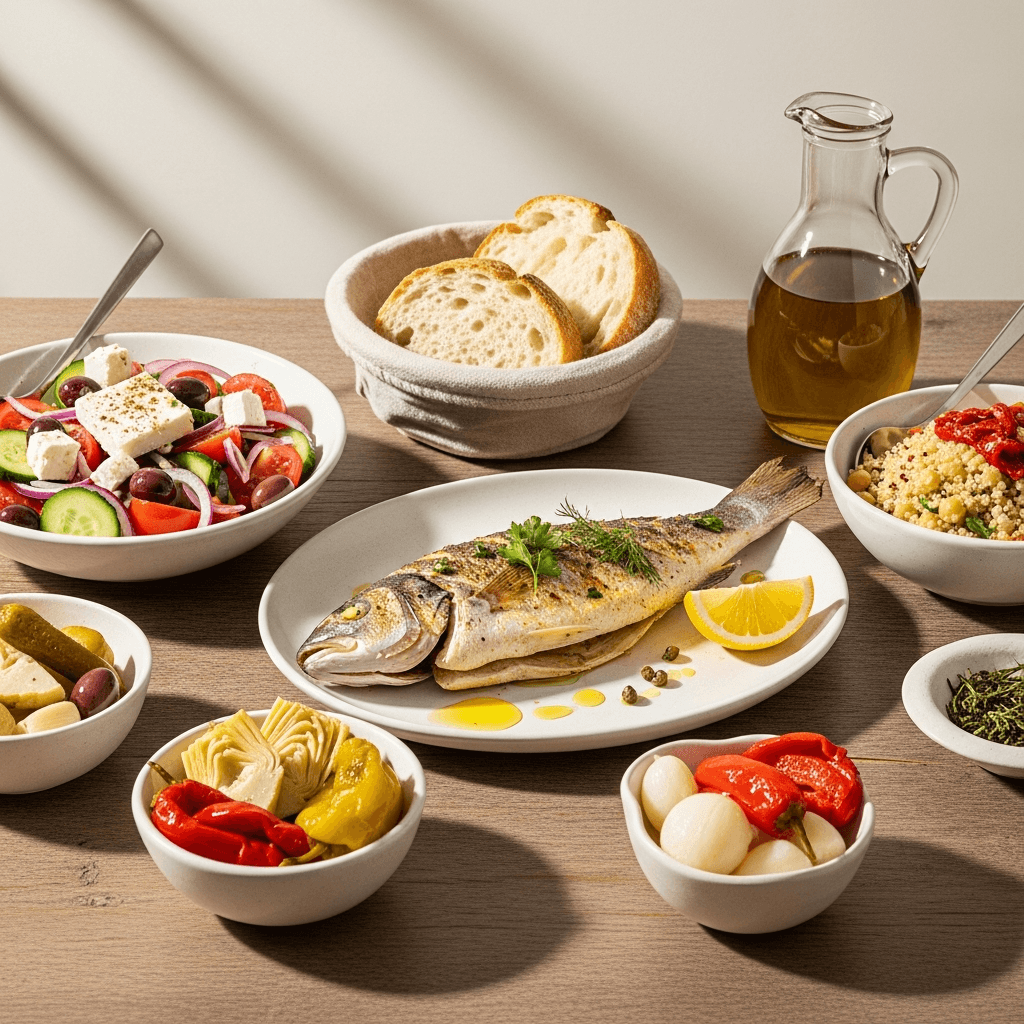
HabitMediterranean dietary pattern
Olive oil, fish, nuts, legumes, plants. The most-studied diet for cardiovascular and cognitive longevity.
Why
The Mediterranean pattern, heavy on plants, olive oil, fish, nuts, legumes; moderate fish and dairy; light on red meat, has the strongest evidence base of any specific diet for long-term cardiovascular and cognitive outcomes. PREDIMED, the largest trial, showed ~30% reduction in major cardiovascular events vs. low-fat control.
Slot in your day
How to do it
How
Olive oil as the primary fat. Plants at every meal. Fish 2–3× per week. Nuts daily (small handful). Red meat once a week or less. Wine optional, with food.
Sticking with it
Stock the kitchen for one week's pattern. Decisions live in the shopping list, not at mealtime.
Markers this may influence
Evidence
PREDIMED (Estruch 2018 NEJM, n=7,447, 4.8-y follow-up): a Mediterranean diet plus extra-virgin olive oil or mixed nuts vs. a low-fat control diet, ~30% reduction in major cardiovascular events (MI, stroke, CVD death). Sofi 2014 updated meta-analysis (n>4M) confirms a dose-response association with all-cause and cardiovascular mortality.
Take to your physician
Worth discussing
- If low, whether your symptoms align and whether further workup (free testosterone, SHBG, LH/FSH, prolactin) is appropriate.
- If considering replacement, the cardiovascular and prostate-related considerations of current evidence.
- Whether lifestyle interventions (sleep, weight loss, resistance training) might address modest symptoms before medical therapy.
Sources
Cited literature
- [1]Bhasin et al., Endocrine Society, Testosterone therapy in men with hypogonadism(2018)
- [2]Davis et al., ISSWSH, Global consensus position statement on the use of testosterone therapy for women(2019)
- [3]Kraemer & Ratamess, Hormonal responses and adaptations to resistance exercise and training (Sports Med)(2005)
- [4]Corona et al., Body weight loss reverts obesity-associated hypogonadotropic hypogonadism: a systematic review and meta-analysis (Eur J Endocrinol)(2013)
Last reviewed May 2026
Keep reading