Imaging
Carotid intima-media thickness
CIMT · Carotid IMT · Carotid ultrasound
A non-invasive ultrasound measurement of arterial wall thickness that captures pre-clinical atherosclerosis years before events.
What it measures
B-mode ultrasound measurement of the combined thickness of the intima and media layers of the common carotid artery (usually 1 cm proximal to the bulb, far wall). Also assesses for plaques. Reported in mm. Most labs report mean and maximum CIMT and presence of any plaque.
Reference context
2 guideline sources
CIMT alone has fallen out of favour for risk reclassification in recent guidelines because plaque detection and coronary calcium provide stronger incremental signal. Where it stays useful: serial monitoring of intervention response (statins, lifestyle), in younger adults where CAC is still zero, and in non-radiation-preferring patients.
Population context: consult guideline targets below
Mechanism
Why moving this marker matters
Intima-media thickening reflects long-term cumulative atherosclerotic exposure. The Lorenz et al. 2007 meta-analysis (37,197 participants across 8 cohorts) found that each 0.1-mm increase in common carotid IMT raised myocardial infarction risk by 15% and stroke risk by 18%, age- and sex-adjusted. The 2011 ARIC follow-up (Polak et al., NEJM) showed plaque presence adds additional predictive value beyond IMT alone.
Guideline targets
What major guidelines recommend
Mannheim Consensus / age-percentile reference
Mean CIMT below the 75th percentile for age/sex; presence of any plaque is a stronger event predictor than CIMT thickness alone.
Common reference (rule of thumb)
CIMT 0.6–0.7 mm typical for young adults; ~1.0 mm common at age 65; ≥1.5 mm with focal protrusion = plaque (Mannheim definition)
How to measure
The test, where to get it, when to repeat
Method
High-resolution B-mode ultrasound, 15–30 minutes, no radiation. Standardised protocol per the Mannheim consensus (Touboul et al. 2012): measure on the far wall of the common carotid artery, 1 cm proximal to the carotid bulb, on end-diastolic frames. Same operator/protocol for serial measurements.
Where
Hospital vascular labs, cardiology imaging centres, dedicated longevity clinics. Increasingly available privately as part of preventive-health packages.
Typical cost
€60–250 private; rarely covered by public systems for primary prevention.
Fasting
Not required
When to test
ACC/AHA 2010
45+Class IIa for cardiovascular risk assessment in asymptomatic adults at intermediate risk where additional risk stratification would change management. Less emphasised in subsequent guidelines as coronary calcium has gained ground.
ESC 2021
May be considered when other risk modifiers are needed; not routine first-line.
Mannheim Consensus 2012
Standardised protocol when CIMT is used clinically or in trials.
Where to scan
Providers offering this imaging study
These providers offer the scan directly to consumers. You book and pay with them; the imaging report lives on their platform. Healicus is not in the clinical chain.
Prescan
DE · EUEuropean preventive-imaging chain offering MRI, CT, DEXA, and vascular screening in German clinics.
Visit Prescan
Life Line Screening
US · UKPop-up vascular screening events — AAA ultrasound and carotid intima-media measurement.
Visit Life Line Screening
Healicus is not the provider. Your contract for the service is with whoever you choose. Links labelled Sponsored are paid affiliate relationships; unlabelled links are editorial reference only. See our disclosure for the full policy.
Context
Reading the numbers
CIMT alone has fallen out of favour for risk reclassification in recent guidelines because plaque detection and coronary calcium provide stronger incremental signal. Where it stays useful: serial monitoring of intervention response (statins, lifestyle), in younger adults where CAC is still zero, and in non-radiation-preferring patients.
Caveats
Operator-dependent reproducibility is the main caveat: track on the same scanner with the same protocol for longitudinal comparison. Equipment quality varies meaningfully between providers.
Practices
What's been shown to influence this marker
 Habit
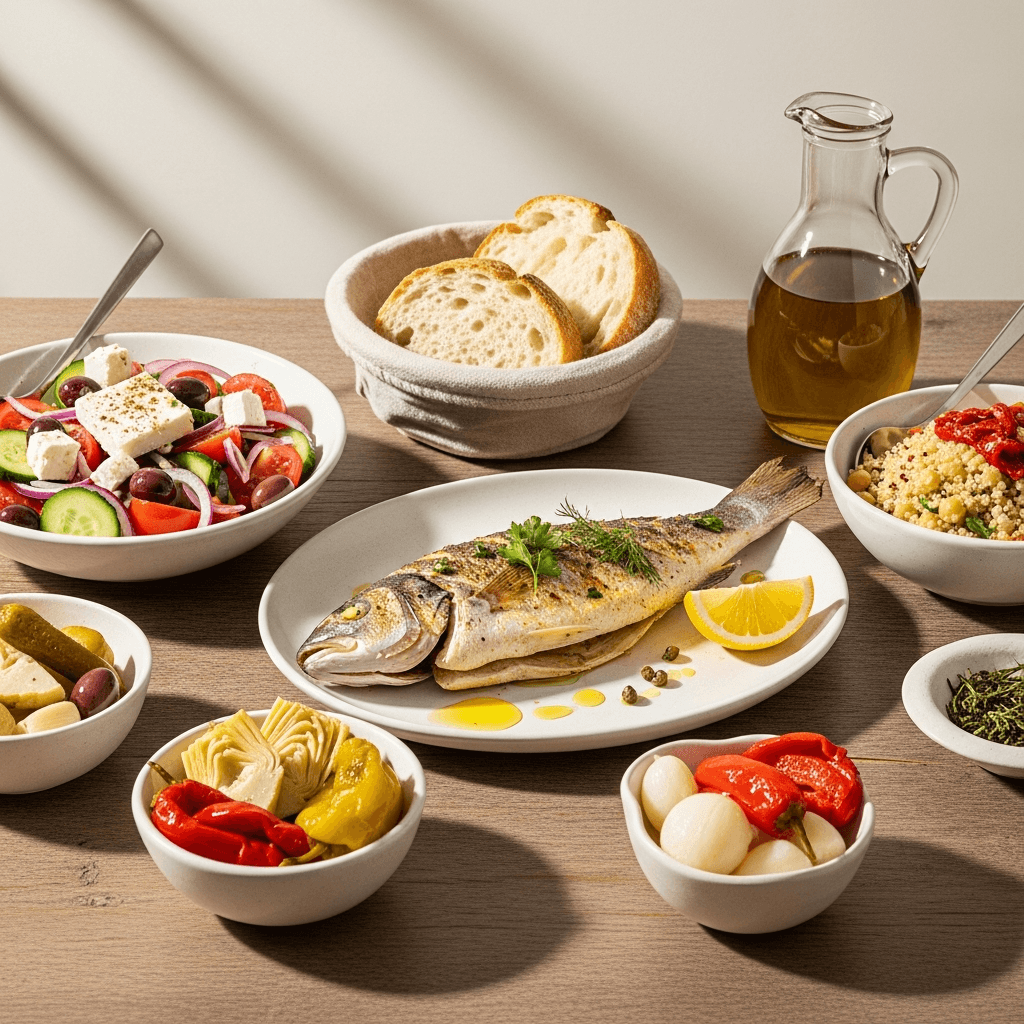
HabitMediterranean dietary pattern
Olive oil, fish, nuts, legumes, plants. The most-studied diet for cardiovascular and cognitive longevity.
Why
The Mediterranean pattern, heavy on plants, olive oil, fish, nuts, legumes; moderate fish and dairy; light on red meat, has the strongest evidence base of any specific diet for long-term cardiovascular and cognitive outcomes. PREDIMED, the largest trial, showed ~30% reduction in major cardiovascular events vs. low-fat control.
Slot in your day
How to do it
How
Olive oil as the primary fat. Plants at every meal. Fish 2–3× per week. Nuts daily (small handful). Red meat once a week or less. Wine optional, with food.
Sticking with it
Stock the kitchen for one week's pattern. Decisions live in the shopping list, not at mealtime.
Markers this may influence
Evidence
PREDIMED (Estruch 2018 NEJM, n=7,447, 4.8-y follow-up): a Mediterranean diet plus extra-virgin olive oil or mixed nuts vs. a low-fat control diet, ~30% reduction in major cardiovascular events (MI, stroke, CVD death). Sofi 2014 updated meta-analysis (n>4M) confirms a dose-response association with all-cause and cardiovascular mortality.
 Habit
HabitZone 2 cardio
Conversational-pace cardio, 150+ minutes per week. Mitochondrial backbone of healthspan.
Why
Zone 2 is the intensity at which you can still hold a conversation but a song would be a stretch, roughly 60–70% of max heart rate. Sustained Zone 2 work increases mitochondrial density, improves fat oxidation, and is the single most consistently associated exercise input with all-cause mortality reduction in cohort studies.
Slot in your day
How to do it
How
Brisk walk, easy bike, slow jog. 30 minutes × 5 days, or 45–60 min × 3 days. The 'talk test' is the simplest gauge.
Ideal for
Anyone over 30; especially valuable as the foundation before adding higher-intensity work.
Sticking with it
Schedule it like a meeting. The session you 'fit in if there's time' is the session that doesn't happen.
Markers this may influence
Evidence
Lee 2012 Lancet Physical Activity Series (population-attributable risk analysis across >50 cohorts): physical inactivity caused ~9% of premature mortality worldwide, comparable to smoking and obesity. Kelly 2014 meta-analysis of walking and cycling (n=280,000 + n=187,000): each ~11 MET-h/week of either activity was associated with ~10–11% lower all-cause mortality.
See also
Related markers
Take to your physician
Worth discussing
- Whether CIMT adds useful information beyond your existing cardiovascular risk assessment (often it doesn't, given coronary calcium).
- If plaque is detected, what management changes are appropriate (typically more aggressive lifestyle + lipid-lowering).
- How to interpret your value against age-/sex-matched percentiles rather than absolute thresholds.
Sources
Cited literature
- [1]Lorenz et al., Prediction of clinical cardiovascular events with carotid intima-media thickness: a systematic review and meta-analysis (Circulation)(2007)
- [2]Touboul et al., Mannheim carotid intima-media thickness and plaque consensus (2004-2006-2011)(2012)
- [3]Polak et al., Carotid-wall intima–media thickness and cardiovascular events (NEJM)(2011)
- [4]Greenland et al., ACCF/AHA 2010 Guideline for assessment of cardiovascular risk in asymptomatic adults(2010)
- [5]ESC 2021 Guidelines on cardiovascular disease prevention in clinical practice(2021)
Last reviewed May 2026
Keep reading
← Previous
Imaging
Polysomnography
The gold-standard sleep study: full electroencephalography, breathing, oxygen, leg movement, and video over one night in a sleep lab.
Next →
Functional test
Grip strength
Five seconds and a dynamometer, one of the strongest single predictors of all-cause mortality independent of age and BMI.