Lab marker
Vitamin B12
Cobalamin · Cbl
Essential cofactor for DNA synthesis and methylation; deficiency is common, often subtle, and slowly reversible.
What it measures
Serum cobalamin concentration. Captures the bulk of circulating B12 (most bound to haptocorrin; only ~20% bound to transcobalamin and biologically active). Reported in pmol/L (SI) or pg/mL (US conversion: 1 pmol/L ≈ 1.357 pg/mL).
Reference context
7 guideline sources
Serum B12 has imperfect sensitivity for true deficiency: some patients with neurological deficiency have 'normal' serum B12. MMA and homocysteine become useful when symptoms suggest deficiency despite a borderline value.
Population context: consult guideline targets below
Mechanism
Why moving this marker matters
B12 is a cofactor for methionine synthase (methylation reactions, including DNA synthesis) and methylmalonyl-CoA mutase (fatty acid metabolism). Deficiency causes megaloblastic anaemia, peripheral neuropathy, cognitive impairment, and elevated homocysteine. Pernicious anaemia (autoimmune intrinsic factor deficiency) and metformin/PPI-induced malabsorption are common adult causes.
Guideline targets
What major guidelines recommend
NICE NG239 (total serum B12, deficiency likely)
<180 ng/L (<133 pmol/L)
NICE NG239 (total serum B12, indeterminate)
180–350 ng/L (133–258 pmol/L)
NICE NG239 (active B12, deficient)
<25 pmol/L
NICE NG239 (active B12, indeterminate)
25–70 pmol/L
BCSH 2014 (deficient)
<148 pmol/L (<200 pg/mL)
BCSH 2014 (borderline)
148–221 pmol/L (200–300 pg/mL), interpret with MMA / homocysteine
BCSH 2014 (replete)
>221 pmol/L (>300 pg/mL)
How to measure
The test, where to get it, when to repeat
Method
Standard blood draw. Serum cobalamin is first-line; methylmalonic acid (MMA) and homocysteine are second-line confirmation when results are borderline. Holotranscobalamin ('active B12') is an emerging alternative measure of biologically available B12.
Where
GP standard panel or private lab.
Typical cost
€15–30 private; bundled in many comprehensive panels.
Fasting
Not required
When to test
BCSH 2014 (Devalia)
Test in adults with unexplained anaemia, macrocytosis, neurological symptoms, glossitis, or risk factors (vegan/vegetarian diet, metformin or PPI use, autoimmune conditions, prior gastrointestinal surgery).
NICE NG239 (UK 2024)
Updated 2024 guideline on B12 deficiency diagnosis and management.
Where to test
Independent labs offering this test
Healicus refers you to independent laboratories. You order from the lab; they take the sample, run it, and return your result on their own platform. Healicus never sees your value.
Randox Health
UK · EU · INTLClinic-based premium panels — wider biomarker breadth than home-test brands.
Visit Randox Health
Synlab
DE · EU · INTLEurope-wide medical lab network — referrals via partner GPs and direct-to-consumer programmes where offered.
Visit Synlab
Cerascreen
DE · EUEstablished German home-test catalogue — ISO-certified labs, German-language reports.
Visit Cerascreen
Medichecks
UKUKAS-accredited home blood-test panels with GP-equivalent biomarker coverage.
Visit Medichecks
Healicus is not the provider. Your contract for the service is with whoever you choose. Links labelled Sponsored are paid affiliate relationships; unlabelled links are editorial reference only. See our disclosure for the full policy.
Context
Reading the numbers
Serum B12 has imperfect sensitivity for true deficiency: some patients with neurological deficiency have 'normal' serum B12. MMA and homocysteine become useful when symptoms suggest deficiency despite a borderline value.
Caveats
Recent B12 supplementation falsely elevates serum cobalamin. Pregnancy lowers values transiently. Taking folic acid can mask the anaemia of B12 deficiency while nerve damage progresses. If both are low, guidelines advise starting B12 before folic acid, under medical supervision.
Practices
What's been shown to influence this marker
Fish, dairy, eggs and meat in a Mediterranean-style diet supply B12. People on strict plant-only diets are at higher risk of deficiency (Pawlak 2014 review) and generally need a B12 source such as fortified foods or supplements.
 Habit
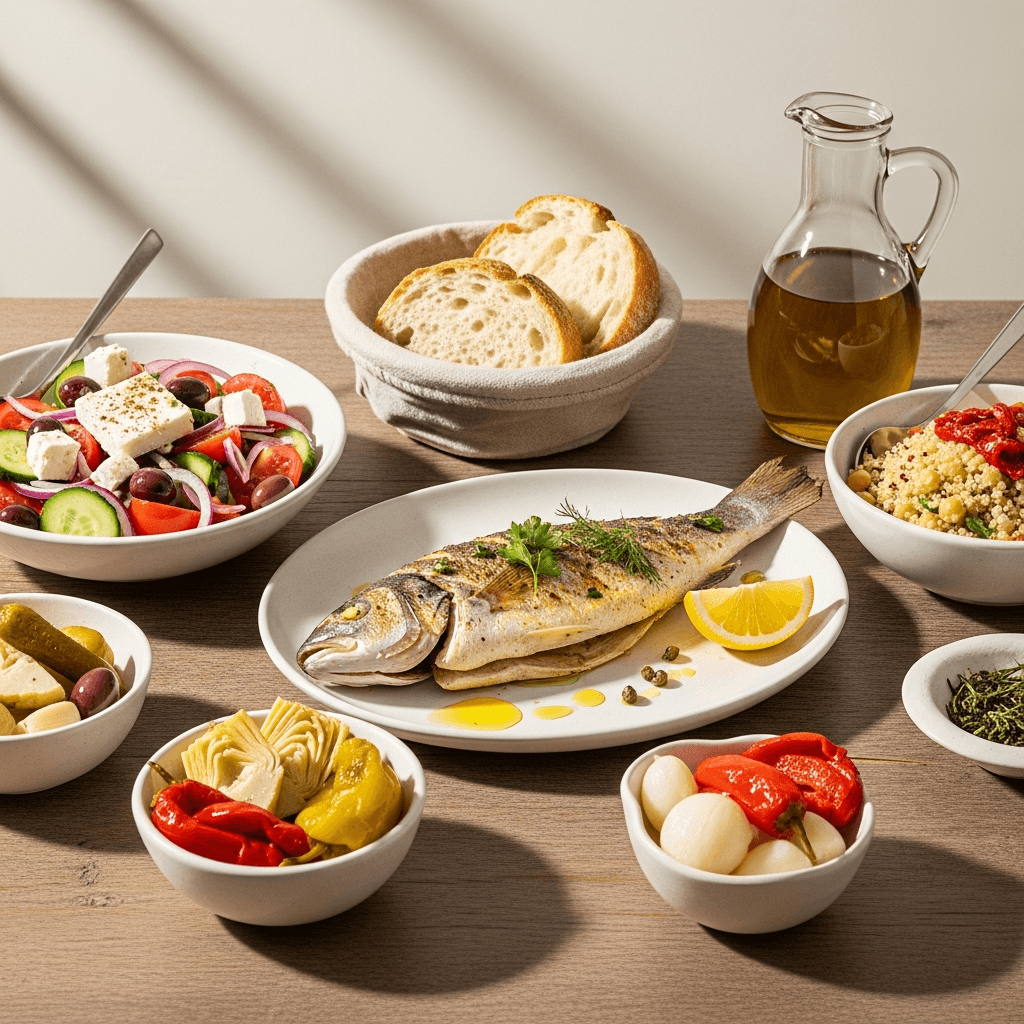
Mediterranean dietary pattern
Olive oil, fish, nuts, legumes, plants. Two randomised trials found fewer major cardiovascular events than a low-fat diet.
Why
The Mediterranean pattern, heavy on plants, olive oil, fish, nuts, legumes; moderate fish and dairy; light on red meat, has randomised-trial evidence for fewer major cardiovascular events than a low-fat diet in adults at high cardiovascular risk. PREDIMED, the largest trial (republished after protocol deviations), showed ~30% fewer major cardiovascular events vs. low-fat control. Trial evidence for cognition is thin.
Slot in your day
How to do it
How
Olive oil as the primary fat. Plants at every meal. Fish 2–3× per week. Nuts daily (small handful). Red meat once a week or less. Alcohol is not needed for the pattern; low-volume drinking has not been shown to be protective.
Sticking with it
Stock the kitchen for one week's pattern. Decisions live in the shopping list, not at mealtime.
Markers this may influence
Evidence
Estruch 2018 N Engl J Med RCT (n=7,447, adults at high cardiovascular risk, republished after protocol deviations): a Mediterranean diet with olive oil or nuts had fewer major cardiovascular events than a control diet advising less fat (hazard ratios 0.69 and 0.72). Delgado-Lista 2022 Lancet RCT (n=1,002, coronary heart disease) found a similar direction versus a low-fat diet, mainly in men. Trial evidence for cognition is thin.
GRADE certainty: Moderate — rated by Healicus using the GRADE method (RCT evidence; downgraded for protocol deviations/no blinding in the main trials and for indirectness of dietary-pattern comparisons)
- Estruch et al., NEJM 2018 (PREDIMED)
- Estruch R et al., Primary Prevention of Cardiovascular Disease with a Mediterranean Diet Supplemented with Extra-Virgin Olive Oil or Nuts, N Engl J Med 2018
- Delgado-Lista J et al., Long-term secondary prevention of cardiovascular disease with a Mediterranean diet and a low-fat diet (CORDIOPREV): a randomised controlled trial, Lancet 2022
- Rees K et al., Mediterranean-style diet for the primary and secondary prevention of cardiovascular disease, Cochrane Database Syst Rev 2019
- Dinu M et al., Mediterranean diet and multiple health outcomes: an umbrella review of meta-analyses of observational studies and randomised trials, Eur J Clin Nutr 2018
- Sofi F et al., Adherence to Mediterranean diet and health status: meta-analysis, BMJ 2008
- Psaltopoulou T et al., Mediterranean diet, stroke, cognitive impairment, and depression: A meta-analysis, Ann Neurol 2013
- Valls-Pedret C et al., Mediterranean Diet and Age-Related Cognitive Decline: A Randomized Clinical Trial, JAMA Intern Med 2015
- Petersson SD, Philippou E, Mediterranean Diet, Cognitive Function, and Dementia: A Systematic Review of the Evidence, Adv Nutr 2016
- NICE guideline (2020): Acute Coronary Syndromes Guideline (NG185) — Secondary Prevention Visual Summary
- USPSTF guideline (2020): Healthy Diet and Physical Activity for Cardiovascular Disease Prevention in Adults With Cardiovascular Risk Factors: Behavioral Counseling Interventions
See also
Related markers
Take to your physician
Worth discussing
- Whether borderline values warrant MMA or holotranscobalamin testing.
- If deficient, the likely cause (dietary, autoimmune pernicious anaemia, malabsorption, medication) and whether oral or intramuscular replacement is appropriate.
- When to retest after starting replacement (typically 3–6 months).
Sources
Cited literature
- [1]Devalia et al., BCSH, Guidelines for the diagnosis and treatment of cobalamin and folate disorders (Br J Haematol)(2014)
- [2]NICE NG239, Vitamin B12 deficiency in over 16s: diagnosis and management(2024)
- [3]Pawlak et al., The prevalence of cobalamin deficiency among vegetarians assessed by serum vitamin B12 (Eur J Clin Nutr)(2014)
Last reviewed October 2026
Keep reading
← Previous
Lab marker
PSA
Men's most-discussed and most-controversial tumour marker, useful but only in the context of informed shared decision-making.
Next →
Lab marker
Folate
Essential for DNA synthesis and methylation. Deficiency is less common where flour is fortified (most EU countries do not mandate this); measured in unexplained anaemia or pregnancy planning.