Lab marker
PSA
Prostate-specific antigen
Men's most-discussed and most-controversial tumour marker, useful but only in the context of informed shared decision-making.
What it measures
A serine protease produced almost exclusively by prostate epithelial cells. Elevated by prostate cancer but also by benign prostatic hyperplasia, prostatitis, recent ejaculation, urinary tract infection, and prostate manipulation (DRE, biopsy, cycling). Reported in ng/mL.
Reference context
2 guideline sources
Single PSA values are noisy; repeat after 4–6 weeks before action, and exclude transient causes (ejaculation, UTI, vigorous exercise). PSA velocity (rate of change) and PSA density (PSA / prostate volume on MRI) refine interpretation. The Stockholm3 test combines PSA with other biomarkers and kallikreins to reduce unnecessary biopsies; ERSPC follow-up confirmed mortality benefit at 16 years for organised screening.
Population context: consult guideline targets below
Mechanism
Why moving this marker matters
Prostate cancer cells leak PSA more freely than normal prostate tissue. Population screening has been shown to reduce prostate-cancer mortality (ERSPC, Göteborg) but at the cost of substantial overdiagnosis and overtreatment of indolent cancers that would never have caused harm. The evidence balance has been the subject of major guideline revisions over the past decade.
Guideline targets
What major guidelines recommend
Common reference (general adult action threshold)
>3 ng/mL → consider further evaluation (mpMRI, repeat testing). >4 ng/mL has been the historical biopsy threshold but is now considered too aggressive.
Age-adjusted reference (rough guide)
<2.5 ng/mL under 50; <3.5 ng/mL 50–59; <4.5 ng/mL 60–69; <6.5 ng/mL 70+
How to measure
The test, where to get it, when to repeat
Method
Standard blood draw. Avoid ejaculation in the 48 hours before testing; avoid testing within 6 weeks of UTI, prostatitis, biopsy, or vigorous cycling.
Where
GP request, private lab, or organised screening programme (Germany: GKV from age 45 with DRE; UK: not offered routinely; US: shared decision-making from age 50, earlier with risk factors).
Typical cost
€20–50 private; covered by most insurers on physician request.
Fasting
Not required
When to test
USPSTF 2018
55–69maleGrade C (individual shared decision-making) for men 55–74. Grade D (recommend against) for men 70+. Strong emphasis on understanding overdiagnosis trade-off.
EAU 2024
50+maleRisk-adapted screening from age 50 (or 45 with family history / African ancestry). Multiparametric MRI before biopsy if PSA elevated.
ACS 2024
maleShared decision-making from age 50; from 45 with elevated risk (family history, African American men).
Where to test
Independent labs offering this test
Healicus refers you to independent laboratories. You order from the lab; they take the sample, run it, and return your result on their own platform. Healicus never sees your value.
Randox Health
UK · EU · INTLClinic-based premium panels — wider biomarker breadth than home-test brands.
Visit Randox Health
Synlab
DE · EU · INTLEurope-wide medical lab network — referrals via partner GPs and direct-to-consumer programmes where offered.
Visit Synlab
Medichecks
UKUKAS-accredited home blood-test panels with GP-equivalent biomarker coverage.
Visit Medichecks
Quest Diagnostics
USDirect-to-consumer ordering via Quest's patient portal — same lab the US healthcare system uses.
Visit Quest Diagnostics
Healicus is not the provider. Your contract for the service is with whoever you choose. Links labelled Sponsored are paid affiliate relationships; unlabelled links are editorial reference only. See our disclosure for the full policy.
Context
Reading the numbers
Single PSA values are noisy; repeat after 4–6 weeks before action, and exclude transient causes (ejaculation, UTI, vigorous exercise). PSA velocity (rate of change) and PSA density (PSA / prostate volume on MRI) refine interpretation. The Stockholm3 test combines PSA with other biomarkers and kallikreins to reduce unnecessary biopsies; ERSPC follow-up confirmed mortality benefit at 16 years for organised screening.
Caveats
PSA screening's benefits and harms balance differently for different men; informed discussion before testing is the standard of care, not optional. A PSA above threshold typically leads to mpMRI before biopsy in modern protocols; this has substantially reduced unnecessary biopsy rates.
Practices
What's been shown to influence this marker
Cohort meta-analyses (Liu 2011, Friedenreich 2016) show modest inverse association between regular physical activity and prostate cancer mortality, though not consistently with PSA values per se. Effect more pronounced for vigorous activity over 3+ hours/week.
Mediterranean dietary pattern adherence is associated with lower aggressive-prostate-cancer incidence in observational cohorts; effects on PSA itself are inconsistent.
Heavy alcohol use shows a modest dose-response association with aggressive prostate cancer; effect on PSA values is small.
 CautionHabit
Limit alcohol intake
Lancet pooled analysis (n=599,912): lowest mortality risk threshold is ~100 g/week, about 5-6 standard drinks total.
Why
Wood et al. 2018 Lancet combined individual-participant data from 83 prospective studies (n=599,912 current drinkers in 19 high-income countries). Above ~100 g/week (about 5-6 UK standard units), all-cause mortality climbs in a dose-response manner. Below that threshold the curve is roughly flat, there is no protective effect. Reductions from heavier intake to ≤100 g/week could add up to 2 years of life expectancy at age 40.
How to do it
How
Track intake honestly for one week. If above threshold, set a weekly cap rather than a daily one (avoids the 'I'll catch up' trap). Several alcohol-free days per week is the simplest pattern. Sleep quality typically improves within 1-2 weeks of reduced intake.
Ideal for
Anyone currently drinking above ~100 g/week (≈one bottle of wine, six pints of beer, or a half-bottle of spirits).
Markers this may influence
Evidence
Wood 2018 Lancet pooled analysis (83 prospective studies, n=599,912 current drinkers across 19 high-income countries): the threshold for lowest all-cause mortality was ~100 g alcohol/week (≈5–6 UK units). Above that, intake is linearly associated with mortality and reduces life expectancy by 1–2 years at age 40 for 200–350 g/week drinkers.
 Habit
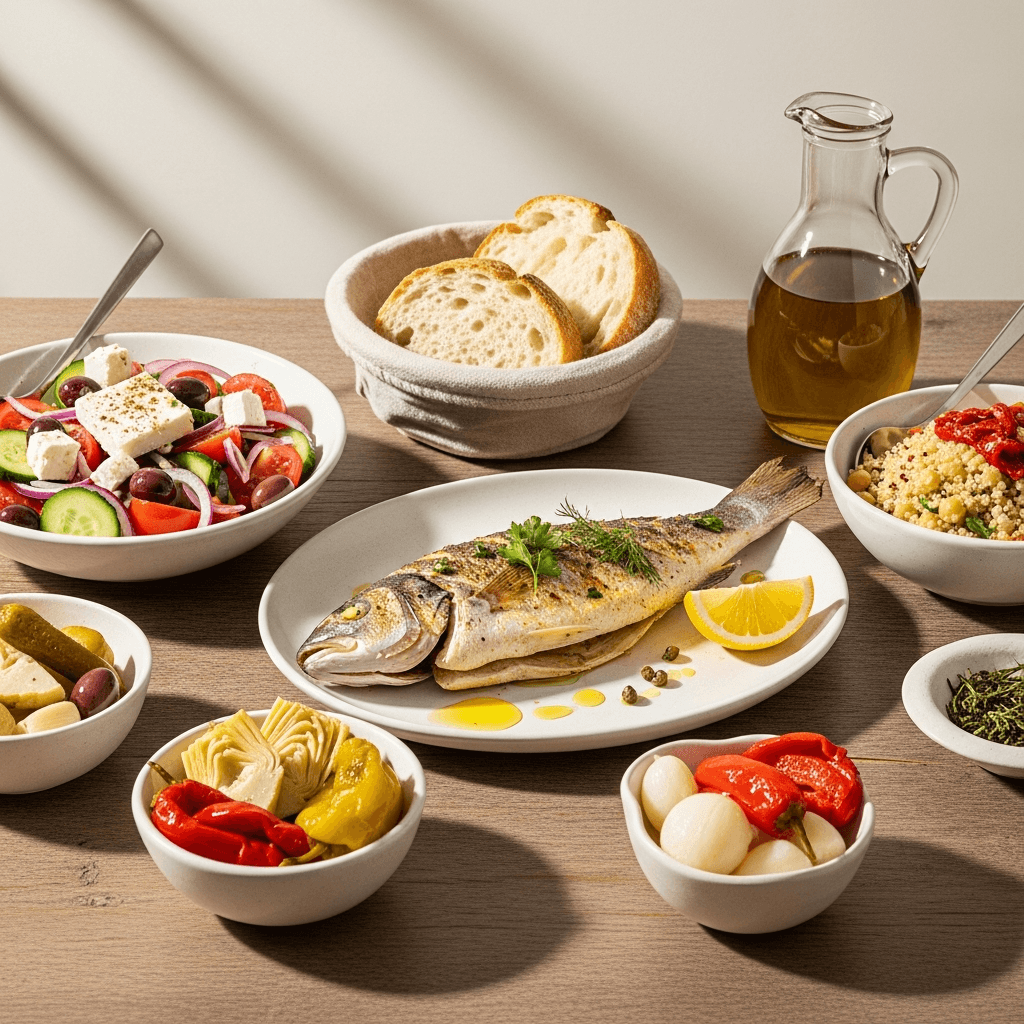
HabitMediterranean dietary pattern
Olive oil, fish, nuts, legumes, plants. The most-studied diet for cardiovascular and cognitive longevity.
Why
The Mediterranean pattern, heavy on plants, olive oil, fish, nuts, legumes; moderate fish and dairy; light on red meat, has the strongest evidence base of any specific diet for long-term cardiovascular and cognitive outcomes. PREDIMED, the largest trial, showed ~30% reduction in major cardiovascular events vs. low-fat control.
Slot in your day
How to do it
How
Olive oil as the primary fat. Plants at every meal. Fish 2–3× per week. Nuts daily (small handful). Red meat once a week or less. Wine optional, with food.
Sticking with it
Stock the kitchen for one week's pattern. Decisions live in the shopping list, not at mealtime.
Markers this may influence
Evidence
PREDIMED (Estruch 2018 NEJM, n=7,447, 4.8-y follow-up): a Mediterranean diet plus extra-virgin olive oil or mixed nuts vs. a low-fat control diet, ~30% reduction in major cardiovascular events (MI, stroke, CVD death). Sofi 2014 updated meta-analysis (n>4M) confirms a dose-response association with all-cause and cardiovascular mortality.
 Habit
HabitZone 2 cardio
Conversational-pace cardio, 150+ minutes per week. Mitochondrial backbone of healthspan.
Why
Zone 2 is the intensity at which you can still hold a conversation but a song would be a stretch, roughly 60–70% of max heart rate. Sustained Zone 2 work increases mitochondrial density, improves fat oxidation, and is the single most consistently associated exercise input with all-cause mortality reduction in cohort studies.
Slot in your day
How to do it
How
Brisk walk, easy bike, slow jog. 30 minutes × 5 days, or 45–60 min × 3 days. The 'talk test' is the simplest gauge.
Ideal for
Anyone over 30; especially valuable as the foundation before adding higher-intensity work.
Sticking with it
Schedule it like a meeting. The session you 'fit in if there's time' is the session that doesn't happen.
Markers this may influence
Evidence
Lee 2012 Lancet Physical Activity Series (population-attributable risk analysis across >50 cohorts): physical inactivity caused ~9% of premature mortality worldwide, comparable to smoking and obesity. Kelly 2014 meta-analysis of walking and cycling (n=280,000 + n=187,000): each ~11 MET-h/week of either activity was associated with ~10–11% lower all-cause mortality.
Take to your physician
Worth discussing
- Whether PSA screening makes sense for you given your age, family history, ethnicity, and personal values about overdiagnosis risk.
- If PSA is elevated, what the workup path looks like (repeat, mpMRI, potentially biopsy) before assuming the worst.
- If diagnosed with prostate cancer, whether active surveillance is appropriate for indolent disease (most early-stage cancers detected by screening qualify).
Sources
Cited literature
- [1]USPSTF 2018, Screening for prostate cancer(2018)
- [2]EAU Guidelines on Prostate Cancer 2024, Screening and early detection(2024)
- [3]Schröder et al., Screening and prostate cancer mortality: results of the ERSPC at 13 years of follow-up (Lancet)(2014)
- [4]Hugosson et al., Mortality results from the Göteborg randomized prostate cancer screening trial(2019)
- [5]American Cancer Society, Prostate Cancer Early Detection Guideline(2024)
- [6]Friedenreich et al., Physical activity and prostate cancer: updated review of the epidemiologic evidence (Curr Opin Urol)(2016)
- [7]Kenfield et al., Mediterranean diet and prostate cancer risk and mortality in the Health Professionals Follow-up Study (Eur Urol)(2014)
- [8]Zhao et al., Alcohol consumption and prostate cancer risk: a dose-response meta-analysis (BMC Cancer)(2016)
Last reviewed May 2026
Keep reading
← Previous
Lab marker
Albumin
The body's most abundant blood protein, a quiet marker of nutritional status, hepatic synthesis, and inflammatory state. Lower values predict mortality across populations.
Next →
Lab marker
Vitamin B12
Essential cofactor for DNA synthesis and methylation; deficiency is common, often subtle, and slowly reversible.