Lab marker
Albumin
Serum albumin
The body's most abundant blood protein, a quiet marker of nutritional status, hepatic synthesis, and inflammatory state. Lower values predict mortality across populations.
What it measures
The main circulating protein, synthesised by hepatocytes. Maintains oncotic pressure, transports many drugs and hormones, and buffers acid-base. Reported in g/L (SI) or g/dL (US).
Reference context
2 guideline sources
Albumin's half-life is ~20 days, so changes reflect medium-term states rather than acute events. Hydration affects readings (dilution by IV fluids lowers; dehydration concentrates).
Population context: consult guideline targets below
Mechanism
Why moving this marker matters
Serum albumin reflects the balance of hepatic synthesis, body protein status, and inflammatory state (it is a negative acute-phase reactant, falls in inflammation). Goldwasser & Feldman 1997 reviewed multiple cohorts and reported each 2.5 g/L decrease in albumin associated with a 24–56% increase in mortality odds. The signal persists across healthy and chronically ill populations.
Guideline targets
What major guidelines recommend
Common reference (adults)
35–50 g/L (3.5–5.0 g/dL)
Risk signal
Values below 38 g/L in community-dwelling older adults associate with elevated mortality even within the 'normal' range
How to measure
The test, where to get it, when to repeat
Method
Standard blood panel; included in routine 'liver function' or 'comprehensive metabolic' panels.
Where
Bundled with standard panels.
Typical cost
Bundled; €5–10 standalone.
Fasting
Not required
When to test
Standard panel inclusion
Reviewed at any routine blood draw. Trend over years carries more signal than any single value.
Where to test
Independent labs offering this test
Healicus refers you to independent laboratories. You order from the lab; they take the sample, run it, and return your result on their own platform. Healicus never sees your value.
Randox Health
UK · EU · INTLClinic-based premium panels — wider biomarker breadth than home-test brands.
Visit Randox Health
Synlab
DE · EU · INTLEurope-wide medical lab network — referrals via partner GPs and direct-to-consumer programmes where offered.
Visit Synlab
Medichecks
UKUKAS-accredited home blood-test panels with GP-equivalent biomarker coverage.
Visit Medichecks
Thriva
UKApp-first subscription home testing, capillary draw, clinician-reviewed reports.
Visit Thriva
Healicus is not the provider. Your contract for the service is with whoever you choose. Links labelled Sponsored are paid affiliate relationships; unlabelled links are editorial reference only. See our disclosure for the full policy.
Context
Reading the numbers
Albumin's half-life is ~20 days, so changes reflect medium-term states rather than acute events. Hydration affects readings (dilution by IV fluids lowers; dehydration concentrates).
Caveats
Inflammation, nephrotic syndrome, severe liver disease, and protein-losing enteropathy all lower albumin independently of nutritional state. A single low reading deserves repeating in context.
Practices
What's been shown to influence this marker
Adequate dietary protein (1.0–1.2 g/kg/day in older adults) supports hepatic albumin synthesis; clinically meaningful albumin changes are slow given the ~20-day half-life.
 Habit
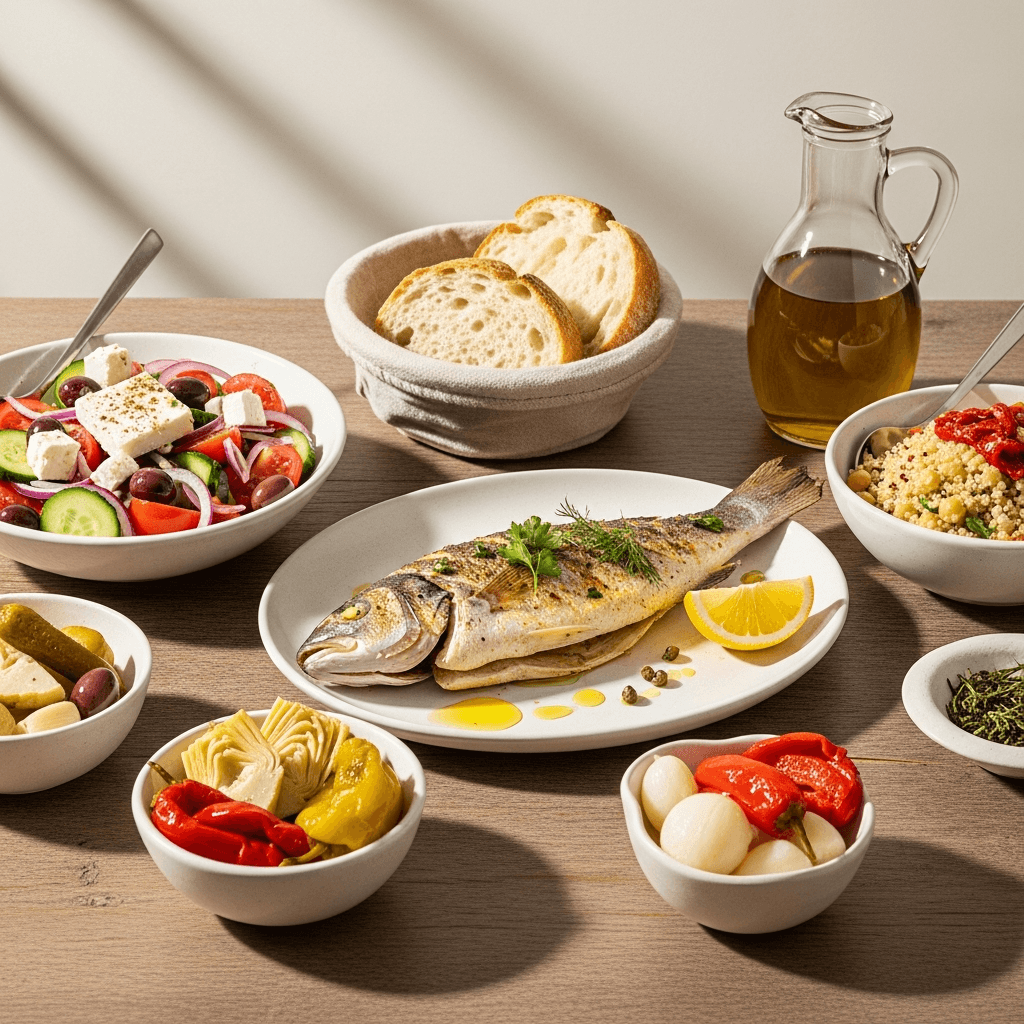
HabitMediterranean dietary pattern
Olive oil, fish, nuts, legumes, plants. The most-studied diet for cardiovascular and cognitive longevity.
Why
The Mediterranean pattern, heavy on plants, olive oil, fish, nuts, legumes; moderate fish and dairy; light on red meat, has the strongest evidence base of any specific diet for long-term cardiovascular and cognitive outcomes. PREDIMED, the largest trial, showed ~30% reduction in major cardiovascular events vs. low-fat control.
Slot in your day
How to do it
How
Olive oil as the primary fat. Plants at every meal. Fish 2–3× per week. Nuts daily (small handful). Red meat once a week or less. Wine optional, with food.
Sticking with it
Stock the kitchen for one week's pattern. Decisions live in the shopping list, not at mealtime.
Markers this may influence
Evidence
PREDIMED (Estruch 2018 NEJM, n=7,447, 4.8-y follow-up): a Mediterranean diet plus extra-virgin olive oil or mixed nuts vs. a low-fat control diet, ~30% reduction in major cardiovascular events (MI, stroke, CVD death). Sofi 2014 updated meta-analysis (n>4M) confirms a dose-response association with all-cause and cardiovascular mortality.
 Habit
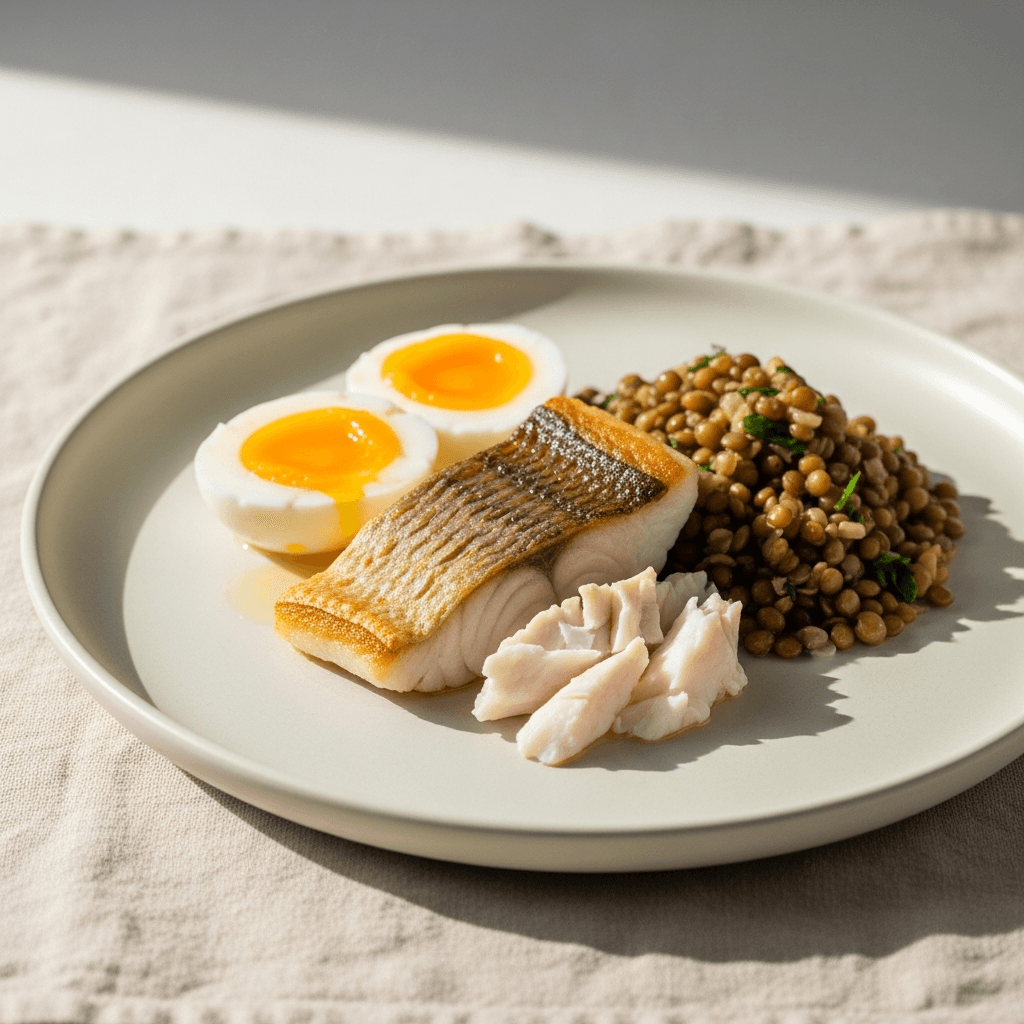
HabitAdequate protein (1.2–1.6 g/kg)
Most adults eat too little protein for muscle preservation through ageing. Aim 1.2–1.6 g/kg body weight.
Why
RDA (0.8 g/kg) is enough to prevent deficiency but not enough to maintain muscle in older age. Studies in adults over 60 consistently show 1.2–1.6 g/kg supports muscle preservation, especially when combined with resistance training. Distribute across meals; ~30g per meal is the upper bound for one-shot synthesis.
Slot in your day
How to do it
How
Calculate target. Track for a week to see baseline. Add eggs, fish, dairy, legumes, or whey to meals to close the gap.
Sticking with it
Anchor 30g of protein at breakfast. It's the meal most people miss.
Markers this may influence
Evidence
Bauer 2013 J Am Med Dir Assoc (PROT-AGE consensus): healthy older adults need 1.0–1.2 g/kg/day protein, and ≥1.2–1.5 g/kg/day in those with acute or chronic disease, to preserve muscle and function. The RDA of 0.8 g/kg is enough to prevent deficiency but not enough to maintain muscle in older age, especially without resistance training as a stimulus.
See also
Related markers
Take to your physician
Worth discussing
- If consistently below 38 g/L, whether nutritional intake, inflammation, or another cause should be investigated.
- Whether your protein intake is adequate for your age and activity level.
- How albumin fits alongside your other markers in your overall picture.
Sources
Cited literature
Last reviewed May 2026
Keep reading