Lab marker
IGF-1
Insulin-like growth factor 1 · Somatomedin C
A growth-hormone-axis proxy with a U-shaped mortality relationship: both very high and very low values associate with elevated risk.
What it measures
Insulin-like growth factor 1, primarily hepatic-derived under growth hormone stimulation. Captures integrated GH-axis activity over hours-to-days. Reported in ng/mL or nmol/L. Strongly age-dependent; declines from peak in adolescence through old age.
Reference context
2 guideline sources
IGF-1 declines roughly 1–2% per year through adulthood. Very high values may suggest acromegaly; very low values in a symptomatic adult may suggest GH deficiency. Mid-normal-for-age values appear lowest-mortality in most cohort meta-analyses.
Population context: consult guideline targets below
Mechanism
Why moving this marker matters
IGF-1 mediates many of GH's anabolic effects on tissues: muscle, bone, organs. The longevity literature presents an apparent paradox: very low IGF-1 (Laron syndrome, calorie restriction) is associated with reduced cancer incidence and extended lifespan in animal models, while in humans, both very low and very high IGF-1 are associated with elevated mortality (U-shaped relationship; Burgers 2011 meta-analysis, Rahmani 2022 meta-analysis).
Guideline targets
What major guidelines recommend
Age- and sex-adjusted reference (lab-specific)
Most labs report results as z-score or % of age-matched reference. Track against percentile rather than absolute value.
Approximate adult reference (lab-dependent)
Ages 30–40: ~120–260 ng/mL; 40–60: ~80–230 ng/mL; 60+: ~60–200 ng/mL
How to measure
The test, where to get it, when to repeat
Method
Standard blood draw. Time of day modestly affects readings; consistent timing useful for trend monitoring. Random measurement is acceptable for screening; diurnal variation is far less than for GH itself.
Where
GP request (often only when GH disorder suspected) or comprehensive private panel.
Typical cost
€30–60 private.
Fasting
Not required
When to test
Endocrine Society 2014 / 2019
Indicated when GH excess (acromegaly) or deficiency is suspected. Routine population screening of healthy adults not recommended.
Where to test
Independent labs offering this test
No direct-to-consumer lab currently in our directory for this marker. Your GP can request it on a standard panel.
Context
Reading the numbers
IGF-1 declines roughly 1–2% per year through adulthood. Very high values may suggest acromegaly; very low values in a symptomatic adult may suggest GH deficiency. Mid-normal-for-age values appear lowest-mortality in most cohort meta-analyses.
Caveats
Acute illness, malnutrition, severe insulin deficiency, and hepatic dysfunction all lower IGF-1 independently of GH-axis status. Oestrogen therapy lowers; testosterone replacement slightly raises.
Practices
What's been shown to influence this marker
Sustained adequate dietary protein modestly raises IGF-1; severe protein restriction lowers it. Within normal Western intake ranges the effect is small.
 Habit
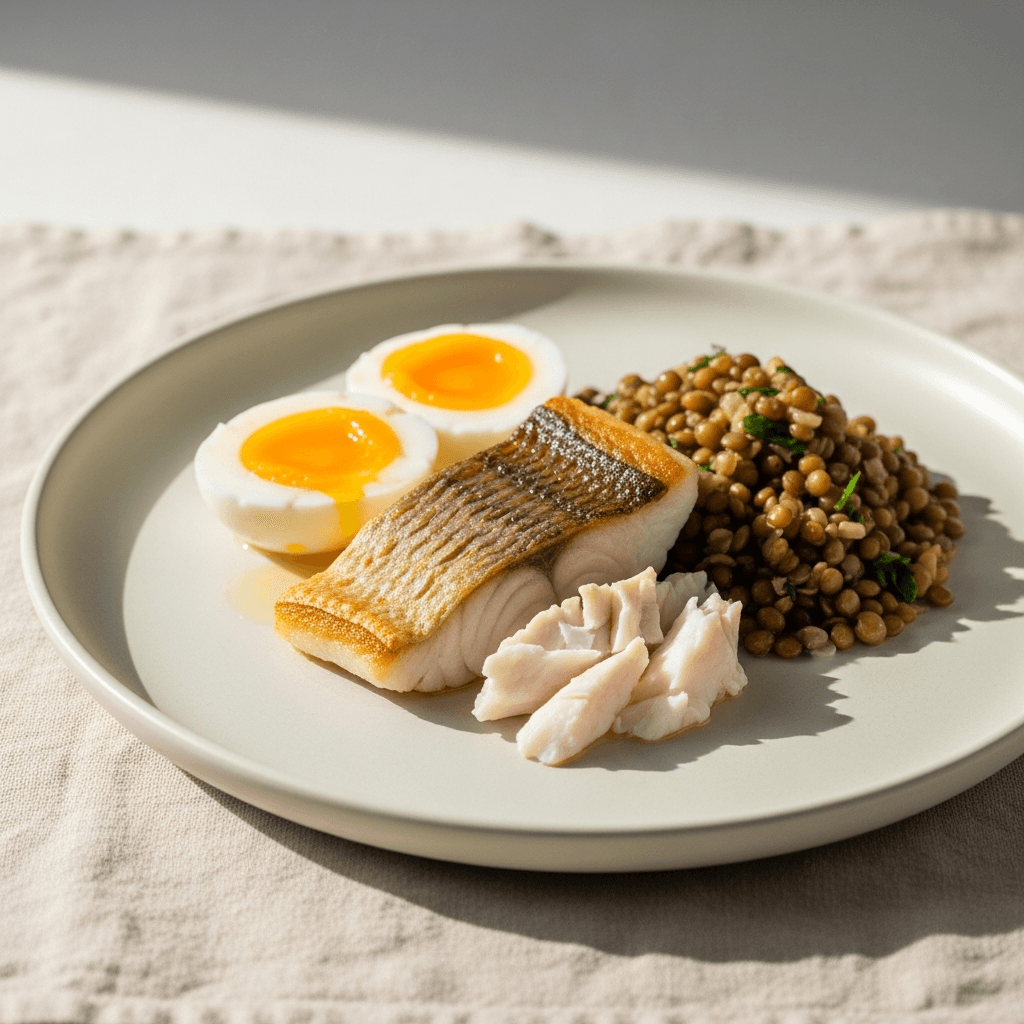
HabitAdequate protein (1.2–1.6 g/kg)
Most adults eat too little protein for muscle preservation through ageing. Aim 1.2–1.6 g/kg body weight.
Why
RDA (0.8 g/kg) is enough to prevent deficiency but not enough to maintain muscle in older age. Studies in adults over 60 consistently show 1.2–1.6 g/kg supports muscle preservation, especially when combined with resistance training. Distribute across meals; ~30g per meal is the upper bound for one-shot synthesis.
Slot in your day
How to do it
How
Calculate target. Track for a week to see baseline. Add eggs, fish, dairy, legumes, or whey to meals to close the gap.
Sticking with it
Anchor 30g of protein at breakfast. It's the meal most people miss.
Markers this may influence
Evidence
Bauer 2013 J Am Med Dir Assoc (PROT-AGE consensus): healthy older adults need 1.0–1.2 g/kg/day protein, and ≥1.2–1.5 g/kg/day in those with acute or chronic disease, to preserve muscle and function. The RDA of 0.8 g/kg is enough to prevent deficiency but not enough to maintain muscle in older age, especially without resistance training as a stimulus.
 Habit
HabitResistance training
2 sessions/week. Preserves muscle mass: the marker that tracks functional independence in your eighties.
Why
Sarcopenia (age-related muscle loss) starts in the third decade and accelerates from 50. Resistance training is the only intervention shown to reverse it. Two sessions per week of full-body work is enough to maintain mass; three is enough to build it. Critical for fall prevention, bone density, and insulin sensitivity in older age.
Slot in your day
How to do it
How
Six compound movements (squat, hinge, push, pull, carry, rotate), 2–3 sets each, 2× per week. Bodyweight is fine to start; progress to weighted as form solidifies.
Ideal for
Everyone, especially those over 40; the cost of starting late is much higher than starting early.
Sticking with it
Two fixed weekday slots beat 'three sessions whenever'. The schedule is the programme.
Markers this may influence
Evidence
Westcott 2012 Curr Sports Med Rep review: 2–3 weekly sessions of resistance training in older adults produced ~1.4 kg of muscle gain and ~1.8 kg fat loss over 10 weeks, with parallel gains in resting metabolic rate and glucose handling. The only intervention shown to reverse age-related sarcopenia, which begins in the third decade and accelerates after 50.
See also
Related markers
Take to your physician
Worth discussing
- If your value is markedly outside the age-adjusted range, whether further endocrine workup is warranted (GH stimulation testing for low values; pituitary MRI for very high values).
- Why mid-normal-for-age is the working interpretation in longevity contexts.
- How to interpret IGF-1 alongside other markers rather than in isolation.
Sources
Cited literature
- [1]Burgers et al., Meta-analysis and dose-response metaregression: circulating insulin-like growth factor I (IGF-I) and mortality (J Clin Endocrinol Metab)(2011)
- [2]Rahmani et al., Association between IGF-1 levels ranges and all-cause mortality: a meta-analysis (Aging Cell)(2022)
- [3]Molitch et al., Endocrine Society Clinical Practice Guideline, Evaluation and treatment of adult growth hormone deficiency(2011)
- [4]Thissen et al., Nutritional regulation of the insulin-like growth factors (Endocr Rev)(1994)
Last reviewed May 2026
Keep reading
← Previous
Lab marker
uACR
The other half of CKD staging: KDIGO weighs urinary albumin co-equally with eGFR, and most adults never have it tested.
Next →
Lab marker
Morning cortisol
The body's master stress hormone, read at its daily peak. A precise clinical tool for adrenal disease, and a contested research window onto chronic stress.