Techniques
Discrete practices you deploy in the moment: breathwork, body scan, progressive relaxation.
Techniques are tools you reach for when triggered: stress in the body, an oncoming panic, sleep that won't come. Unlike habits, they're not daily commitments. They're skills practiced enough that you can deploy them when needed. Every entry has clinical-trial evidence behind it.
Techniques catalogue
10 evidence-anchored techniques, strongest evidence first.
Music for stress
Deliberate listening measurably lowers heart rate, blood pressure, and cortisol. 104 trials say your wind-down playlist is a real intervention.
Why
Intentional music listening — slow tempo, chosen for the moment, attended to rather than backgrounded — reliably shifts both physiological arousal (heart rate, blood pressure, stress hormones) and the subjective sense of stress. Two large multilevel meta-analyses (104 RCTs of music interventions; 47 studies of therapist-delivered music therapy) found significant medium effects on stress-related outcomes.
The technique
- 1
Choose slow-tempo music you genuinely like — familiarity beats prescription playlists.
- 2
Remove the competing task: listening is the activity.
- 3
15–30 minutes, after acute stress or before bed.
- 4
Optional: pair with slow exhale-led breathing for a compounding effect.
When to use it
After a hard meeting, commute decompression, pre-sleep wind-down.
Ideal for
Everyone with a music library; especially useful where "sit still and meditate" advice has failed.
Evidence
de Witte 2020 Health Psychol Rev — 104 RCTs, n=9,617: significant effects of music interventions on physiological (d≈0.38) and psychological (d≈0.54) stress outcomes; largest on heart rate. Companion meta-analysis of therapist-delivered music therapy (47 studies) found medium-to-large effects.
Aromatherapy (inhalation)
Lavender-led scent inhalation, the best-studied corner of essential-oil use: moderate-certainty evidence for acute anxiety relief.
Why
Inhalation aromatherapy — a few drops of essential oil in a diffuser or on a tissue — is the form of essential-oil use with usable clinical evidence, mostly for situational anxiety. A meta-analysis in cardiovascular patients (12 RCTs) graded the anxiety effect moderate-certainty, with lavender the most-studied oil. Distinct from oral lavender-oil capsules (Silexan), which have their own trial base and their own entry.
The technique
3–5 drops in a diffuser for 30–60 minutes, or 1–2 drops on a tissue held near the nose for several minutes. Topical use only diluted 1–3% in a carrier oil.
Ideal for
Situational anxiety — pre-procedure, pre-sleep, travel. People who want a low-effort sensory cue for wind-down.
Evidence
Turan Kavradim 2021 meta-analysis, 12 RCTs in cardiovascular patients — inhalation aromatherapy (mostly lavender) reduced anxiety with moderate GRADE certainty, plus small drops in systolic BP and heart rate. Trials are short and exposure-bound; no durable-effect claims.
Body scan meditation
Move attention slowly from feet to head. The core MBSR component, lying down — no cushion or lotus required.
Why
The body scan systematically walks attention through the body, noticing sensation without changing anything. It is the first formal practice taught in MBSR and the easiest meditation entry point for people who find breath-watching frustrating. Meta-analytic evidence for mindfulness programmes shows moderate improvements in anxiety, depression, and pain — the body scan is their workhorse component.
The technique
- 1
Lie on your back, arms at your sides; set a guided track or a 20-minute timer.
- 2
Bring attention to the toes of one foot; just notice — warmth, contact, tingling, nothing.
- 3
Move region by region up the body at a steady pace.
- 4
When the mind wanders, return to the last body part without commentary.
When to use it
Bedtime, post-work decompression, or as the daily formal practice in an MBSR course.
Ideal for
Meditation sceptics, racing minds at bedtime, anyone who falls asleep during savasana and doesn't mind.
Evidence
Goyal 2014 JAMA Intern Med meta-analysis (47 trials, n=3,515) — mindfulness meditation programmes produced moderate improvements in anxiety, depression, and pain at 8 weeks. Evidence is for structured programmes in which the body scan is a core component.
 Technique
Box breathing (4-4-4-4)
Slow paced breathing at ~6 breaths/min raises vagal tone and shifts the autonomic balance.
Why
Slow paced breathing at ~6 breaths/min raises vagal tone and shifts the autonomic balance. Free, instant, no contraindications.
The technique
- 1
Inhale slowly through the nose for 4 seconds.
- 2
Hold the breath in, relaxed, for 4 seconds.
- 3
Exhale slowly through the nose or pursed lips for 4 seconds.
- 4
Hold the breath out, relaxed, for 4 seconds, then repeat.
Evidence
Laborde 2022 Neurosci Biobehav Rev meta-analysis (223 studies): paced breathing at ~6 breaths/min, the rhythm box-breathing produces, reliably increases vagally-mediated HRV both during and immediately after practice. Free, instant, no known contraindications; effect size acute and modest, cumulative effects emerge with regular practice.
Guided imagery
A narrated mental walk through a calm scene. Matches PMR for relaxation in head-to-head trials — and all you need is audio.
Why
Guided imagery uses recorded or scripted narration to walk you through a multi-sensory calm scene. The vividness does the work: attention loads onto the imagined environment and displaces threat processing. In a randomized head-to-head comparison it increased psychological and physiological relaxation comparably to progressive muscle relaxation.
The technique
- 1
Choose a recorded imagery session (10–20 minutes).
- 2
Settle somewhere quiet, eyes closed, and follow the narrated scene.
- 3
Engage every sense the narration offers — temperature, sound, light.
- 4
Practice daily or before anticipated stress (procedures, presentations, sleep).
When to use it
Pre-procedure or pre-presentation nerves, bedtime, or scheduled daily downshift.
Ideal for
Visual thinkers; people who find body-focused techniques (breath counts, muscle tensing) effortful.
Evidence
Toussaint 2021 randomized comparison (n=60) — 20 minutes of guided imagery raised psychological relaxation vs control, comparable to PMR, with an immediate physiological relaxation trend. Wider literature is dominated by small peri-operative and oncology trials: consistent direction, modest scale.
HRV biofeedback
Train your heart-rate variability against a live readout. Large effects on stress and anxiety across 24 trials.
Why
Heart-rate-variability biofeedback pairs slow breathing with a live HRV readout from a chest strap, ear clip, or wearable, teaching you to push your own autonomic balance toward parasympathetic dominance. Unlike unguided breathing, the feedback loop makes the training measurable — you watch coherence rise as you settle. A meta-analysis of 24 studies found large reductions in self-reported stress and anxiety.
The technique
- 1
Get a sensor an HRV app can read in real time (chest strap, ear clip, or supported watch).
- 2
Sit comfortably and breathe out longer than in, near 6 breaths per minute.
- 3
Watch the live trace and adjust pace until coherence holds high.
- 4
Train 10–20 minutes daily; re-test resting HRV after 4–8 weeks.
When to use it
Daily training block, or before a high-stakes meeting once the skill is grooved.
Ideal for
Data-minded people who already own a wearable, and anyone who wants stress training with a visible score.
Markers this may influence
Evidence
Goessl 2017 Psychol Med meta-analysis, 24 studies (n=484) — large reductions in self-reported stress and anxiety (Hedges' g ≈ 0.8) vs control; effect held regardless of session count. More sham-controlled trials still wanted.
Progressive muscle relaxation
Tense each muscle group, then let go. The classic evidence-backed unwind sequence from 1930s physiology that still outperforms most relaxation apps.
Why
Progressive muscle relaxation (PMR) cycles through the body's muscle groups — tense for a few seconds, release, notice the contrast. The deliberate tension makes the release tangible, which is why it works for people who "can't relax on command". It is a standard component of CBT for anxiety and insomnia, with a 2024 systematic review supporting effects on stress, anxiety, and depression.
The technique
- 1
Lie down or recline. Start at the feet: tense the muscles hard for ~5 seconds.
- 2
Release fully and rest in the contrast for 10–20 seconds.
- 3
Move up: calves, thighs, glutes, abdomen, hands, arms, shoulders, face.
- 4
Finish with three slow exhales; scan for any group still holding.
When to use it
Bedtime wind-down, or any time physical tension is the dominant stress signal.
Ideal for
Body-tension carriers: clenched jaw, raised shoulders, restless legs at bedtime.
Evidence
A 2024 systematic review (46 studies) supports PMR for stress and anxiety reduction in adults; in Toussaint 2021's head-to-head RCT, PMR matched guided imagery and deep breathing for psychological relaxation while showing an immediate physiological relaxation trend.
 Technique
Slow-exhale breathing
4-second inhale, 6-second exhale. Activates parasympathetic recovery in 2 minutes.
Why
Long exhales activate the vagus nerve and shift autonomic balance toward parasympathetic dominance. The technique is shared by Stoic philosophy, pranayama, and modern resonance breathing protocols. Effects are immediate and accumulate with regular practice.
The technique
- 1
Sit upright, shoulders relaxed.
- 2
Inhale through the nose for 4 counts.
- 3
Exhale through pursed lips for 6 counts.
- 4
Continue for 2 minutes for an acute effect, 5-10 minutes daily for baseline tone.
When to use it
Pre-meeting nerves, post-conflict, sleep wind-down, or whenever the body feels keyed up.
Ideal for
In-the-moment stress regulation, pre-sleep wind-down, post-conflict recovery.
Markers this may influence
Evidence
Laborde 2022 Neurosci Biobehav Rev meta-analysis (223 studies) confirms voluntary slow breathing reliably raises vagally-mediated HRV both during and immediately after practice. Lehrer 2020 Front Neurosci synthesises the resonance-breathing literature: ~6 breaths/min consistently peaks HRV amplitude.
 Technique
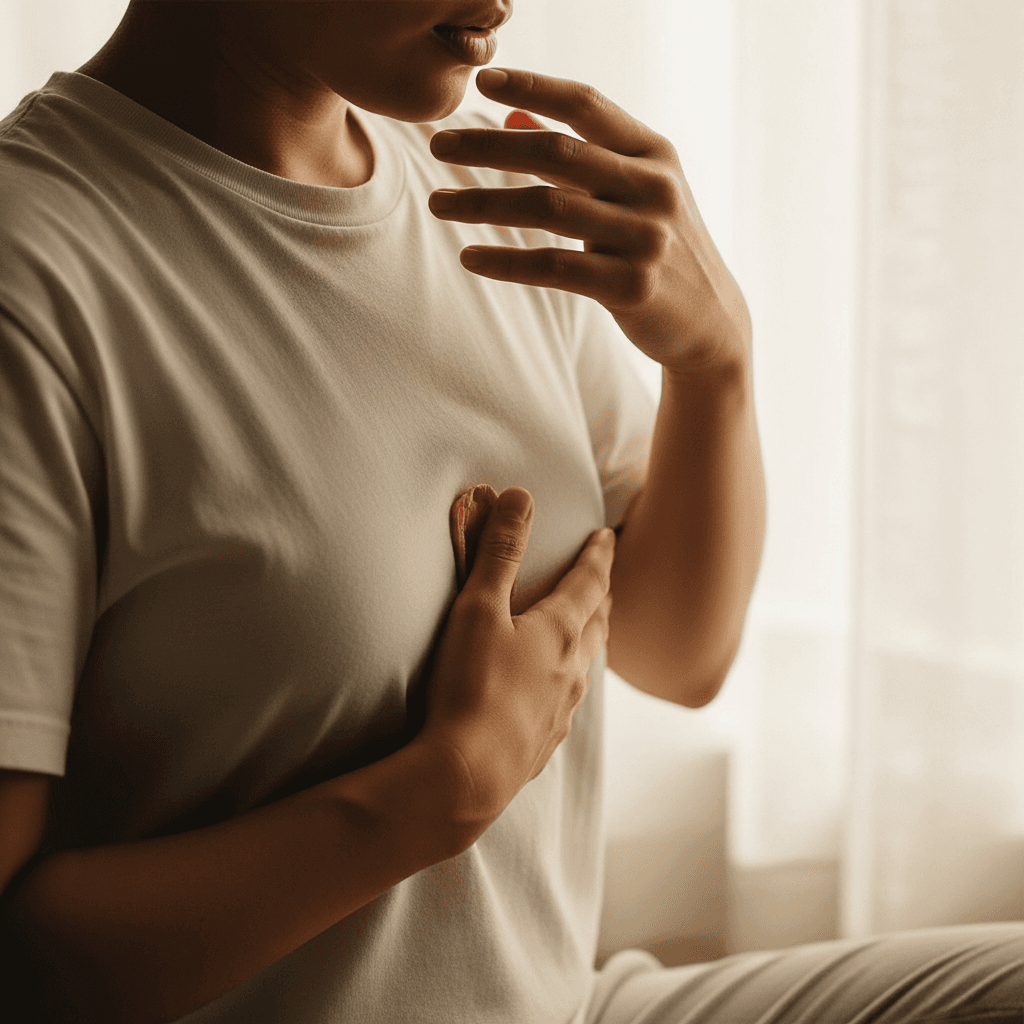
4-7-8 breathing
Inhale 4, hold 7, exhale 8: extends the exhale to activate parasympathetic recovery.
Why
A breathing pattern derived from pranayama and popularised by Dr. Andrew Weil. Long exhales relative to inhales bias the autonomic nervous system toward parasympathetic dominance. RCT evidence shows acute effects on heart-rate variability and blood pressure, plus improved post-surgical anxiety scores in a 2023 trial.
The technique
- 1
Sit or lie comfortably. Tongue tip lightly behind the upper teeth.
- 2
Exhale fully through the mouth.
- 3
Inhale through the nose for a count of 4.
- 4
Hold the breath for a count of 7.
- 5
Exhale through the mouth for a count of 8.
- 6
Repeat the cycle 4 times. That's one round.
When to use it
Lying in bed when sleep won't come, or in any acute-stress moment.
Markers this may influence
Evidence
Laborde 2022 Neurosci Biobehav Rev meta-analysis (223 studies) confirms slow-paced breathing reliably raises vagally-mediated HRV during and immediately after practice. The 4-7-8 protocol specifically has only small acute trials (Vierra 2022 Physiol Rep), so the effect on sleep is mechanistically plausible but not anchored to a large RCT.
 Technique
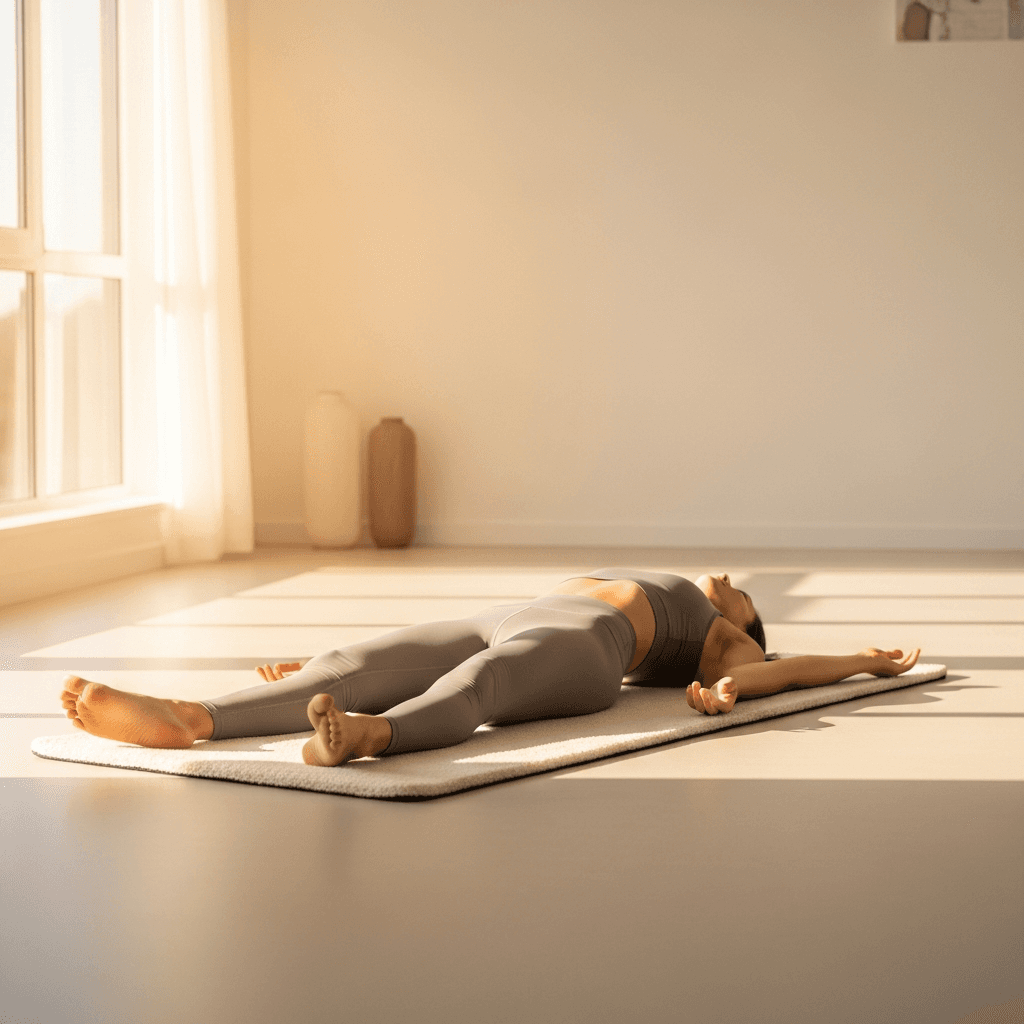
Yoga nidra (NSDR)
Guided non-sleep deep rest; 20 minutes can substitute for missed sleep on tough nights.
Why
Yoga nidra is a guided body-scan practice that produces a state physiologically similar to early-stage sleep. Research from Andrew Huberman's lab and others shows it increases dopamine in striatum and reduces sympathetic tone. Useful for sleep-onset difficulty, recovery on short-sleep days, and as a midday reset.
The technique
- 1
Lie flat on your back, arms slightly away from body, eyes closed.
- 2
Start a guided 20-minute audio (search 'NSDR' or 'yoga nidra').
- 3
Follow the body-scan instructions: attention moves through each body part.
- 4
Don't try to stay awake. Drifting is part of it.
- 5
End: take a slow breath, wiggle fingers and toes before sitting up.
When to use it
Use mid-afternoon for an energy reset, or in bed when sleep won't come.
Ideal for
People who lie in bed unable to switch off; shift workers needing a daytime reset.
Markers this may influence
Evidence
Kjaer 2002 Cognitive Brain Res PET study (experienced practitioners): yoga nidra was associated with a 65% increase in endogenous striatal dopamine release during the practice, a mechanistic signal for the reported parasympathetic shift. Trial evidence in unselected adults is preliminary; safe and acutely calming, but chronic-outcome data are limited.
Where this fits in your routine
Browse by what you're trying to improve: